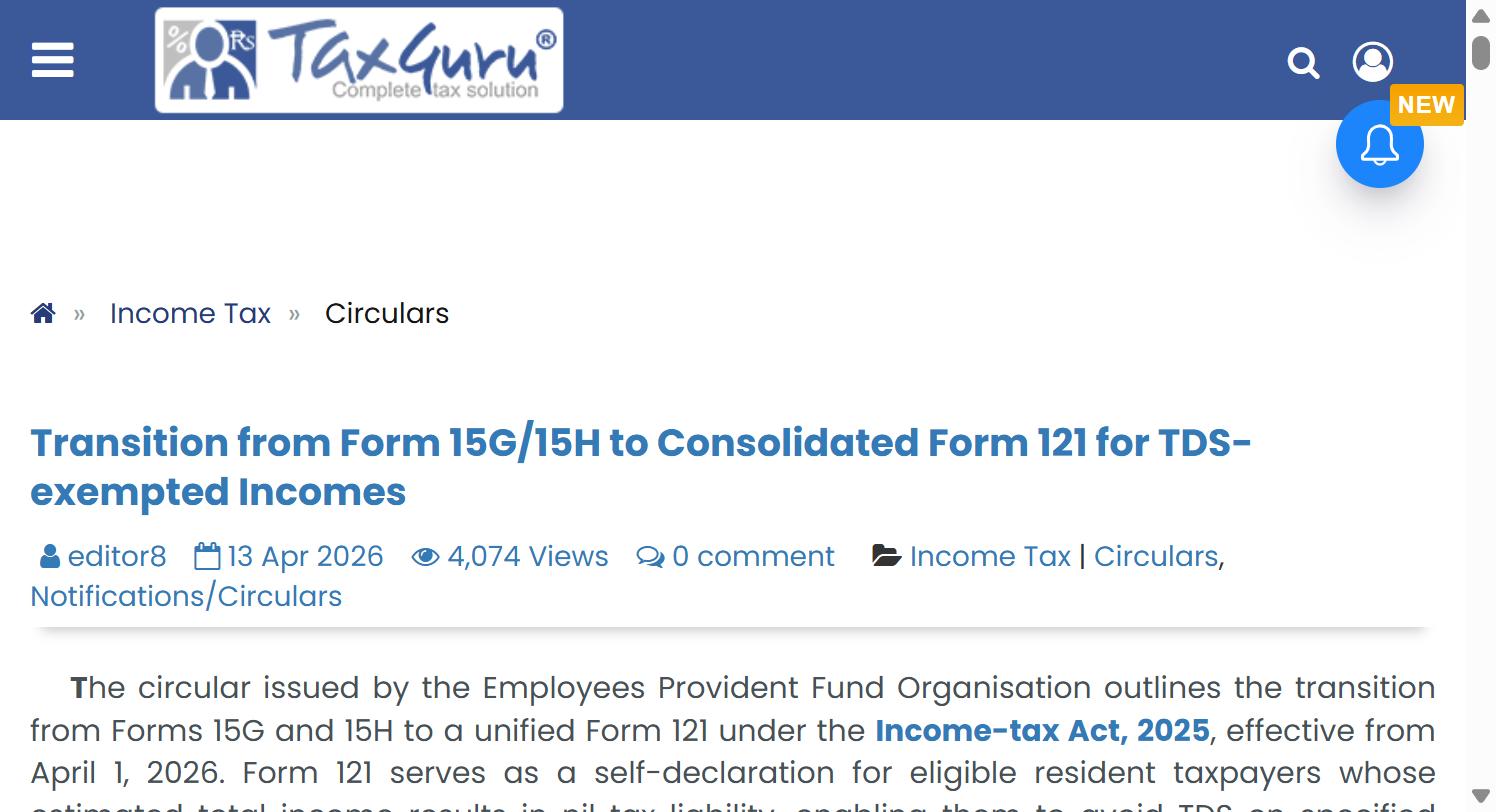
Form 121 Replaces Forms 15G and 15H Under the New Income Tax Act 2025: All You Need to Know

Effective 1st April 2026, the familiar Forms 15G and 15H that millions of Indians used to avoid TDS on interest, dividends, and provident fund withdrawals have been replaced by a single unified declaration — Form 121. This change comes as part of the transition to the new Income Tax Act 2025, with Form 121 corresponding to Section 393(6) of the new Act and Rule 211 of the Income-tax Rules 2026.

What is Form 121? Form 121 is a self-declaration submitted by a resident taxpayer to their payer (bank, EPFO, post office, company, etc.) stating that their estimated total income for the year is nil — i.e., no tax liability. Based on this declaration, the payer does not deduct TDS on specified incomes such as bank interest, PF withdrawals, mutual fund income, insurance commission, rent, and dividends.

Who can file Form 121? Resident individuals (below 60 and 60 years or above), HUFs, and other specified entities can file Form 121. Companies and firms are NOT eligible. Non-residents cannot use this form. Unlike before, where Form 15G was for individuals below 60 and Form 15H for senior citizens, Form 121 now serves both groups under one unified format.

Key compliance requirements: PAN is mandatory and the declaration must be submitted to each payer separately before income is credited or paid. Payers must assign a Unique Identification Number (UIN) to each Form 121 received and upload a consolidated monthly statement by the 7th of the following month. The UIN must also be quoted in quarterly TDS returns (Form 140).

Digital features: The new Form 121 is a smart form with auto-population of data, real-time validations, API integration, and standardized fields. The Income Tax Department is developing online filing facilities through the e-filing portal.

For existing declarations: Forms 15G/15H submitted for the period from 1st April 2026 should not be returned to members — instead, Form 121 should be collected going forward.

Need help with Form 121 compliance? SpotOn Business Solutions LLP is here to guide you through the transition. Reach out today.
Read more...
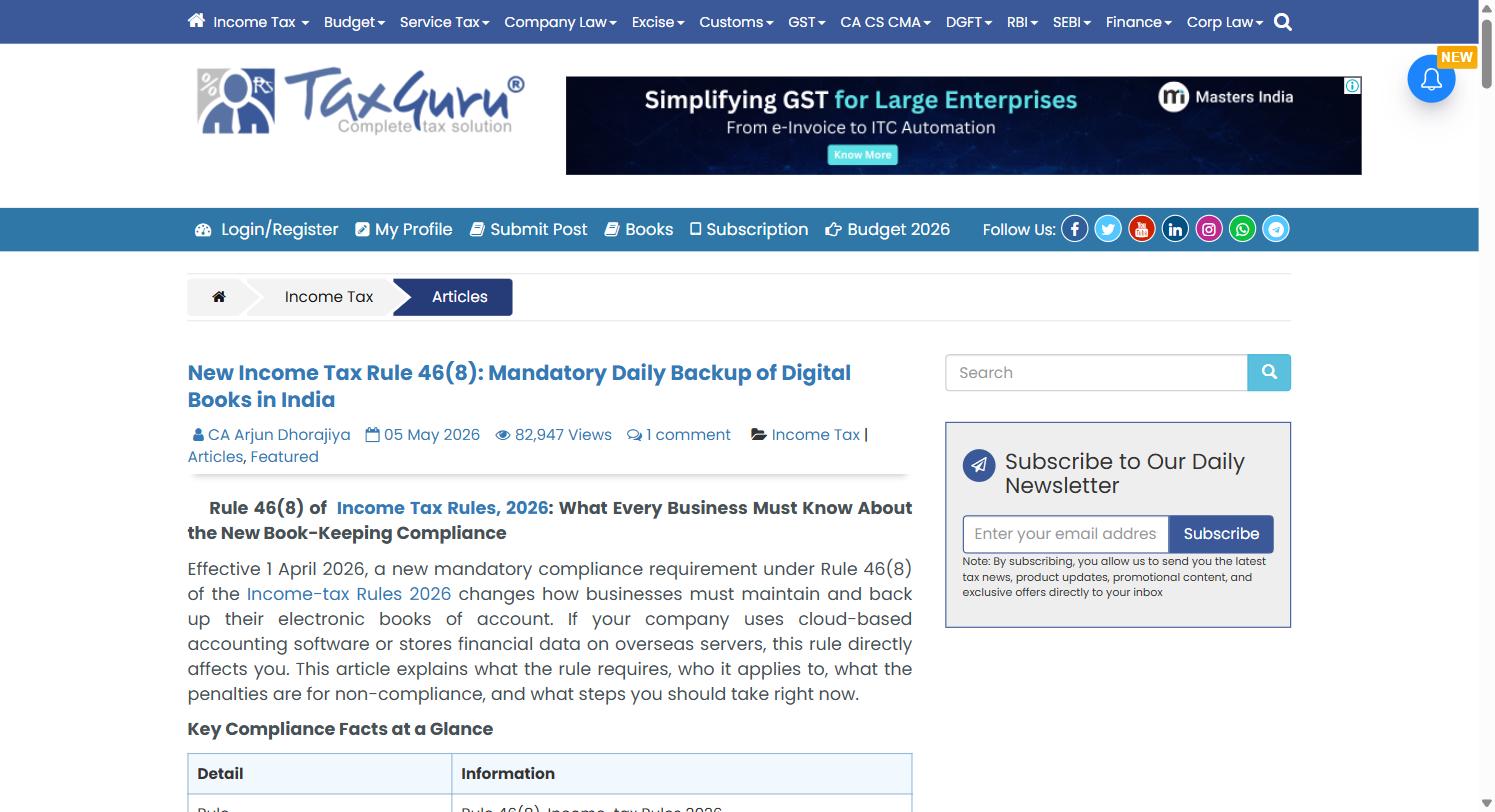
Rule 46(8) Income Tax Rules 2026: Mandatory Daily Backup of Digital Books of Account

Effective 1st April 2026, a new compliance requirement under Rule 46(8) of the Income-tax Rules 2026 mandates that every person maintaining their books of account in electronic form must create a daily backup of their data. This rule is particularly relevant for businesses using cloud-based accounting software or servers hosted outside India.

What does Rule 46(8) require? Any person whose books of account are maintained electronically must ensure that a backup is created each day. If the data is stored on a server outside India, the backup must also be kept on a server within India. The rule aims to ensure that tax records are accessible and preserved for audit and scrutiny purposes under the new Income Tax Act 2025.

Who does this apply to? The rule applies to all businesses, professionals, and individuals required to maintain books of account under the Income Tax Act. This includes companies using popular cloud-based accounting platforms where servers may be located abroad, making India-based backup compliance particularly critical.

Penalties for non-compliance: Failure to comply with Rule 46(8) can attract penalty proceedings under the Income Tax Act 2025. Non-compliance during a tax scrutiny or survey could also raise red flags with the Assessing Officer.

Practical steps to comply: First, check where your accounting software stores data. If it is on overseas servers, ensure your provider offers an India-based data residency option or set up a local backup process. Second, configure automated daily backups and maintain backup logs. Third, ensure backups are retrievable and readable for tax audit purposes.

This new rule affects users of Tally offline, QuickBooks, Zoho Books, and similar platforms. SpotOn Business Solutions LLP can help you assess your current setup and build a compliant digital bookkeeping process. Contact us today.
Read more...

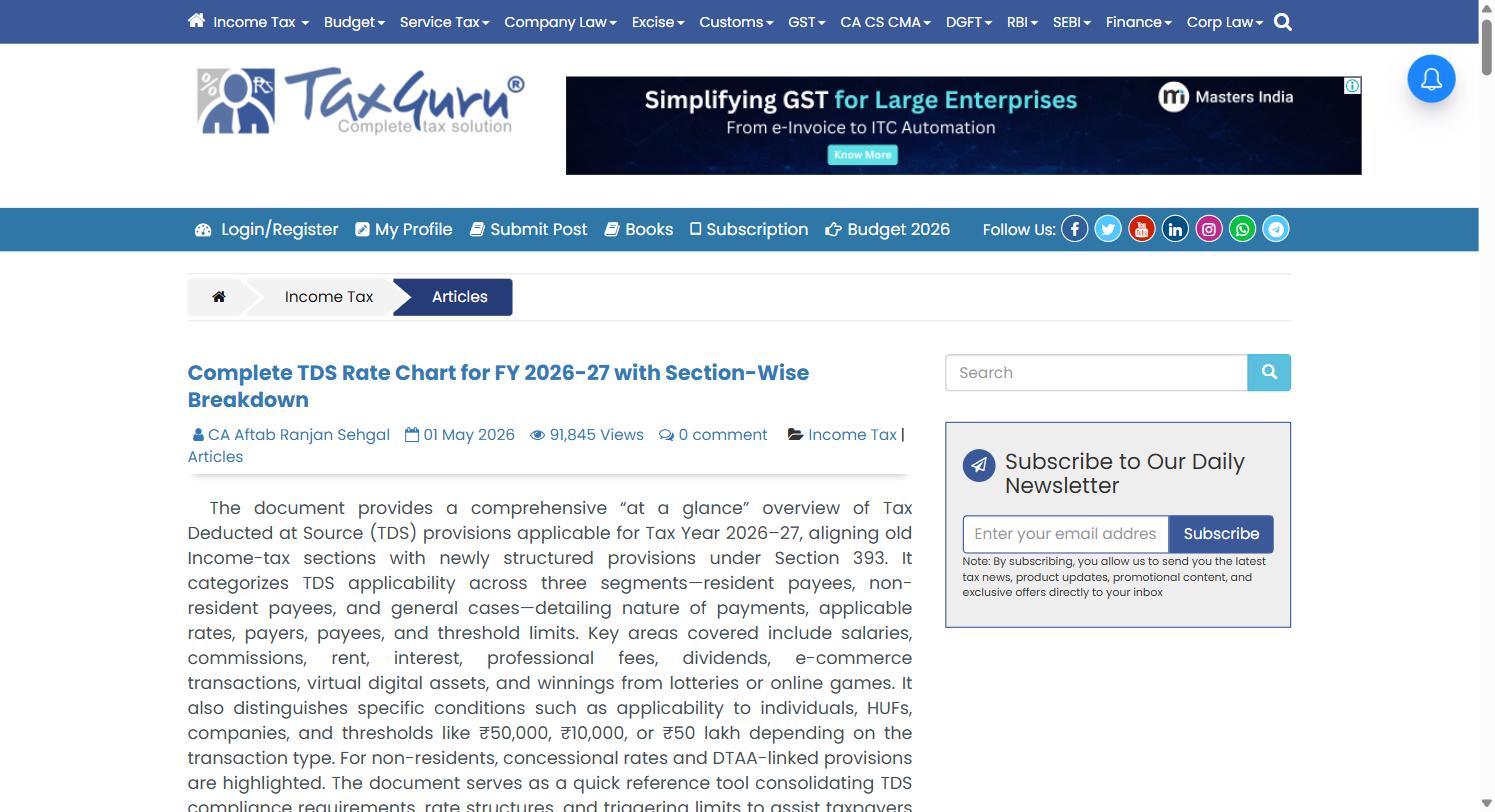
TDS Rate Chart for FY 2026-27: Section-Wise Breakdown Under the New Income Tax Act 2025

With the New Income Tax Act 2025 coming into effect from 1st April 2026, TDS (Tax Deducted at Source) provisions have been reorganised under a new Section 393, replacing the earlier scattered framework of 65+ individual sections. This streamlining is one of the most practically significant changes for employers, businesses, and professionals.

Under the new structure, TDS applicability is categorised into three clear segments: resident payees, non-resident payees, and general cases. For resident payees, key rates include: salary under Section 392 at slab rates; commission at 2% above Rs.20,000; rent to individuals/HUF at 2% above Rs.50,000/month; rent on property by others at 10%; professional fees at 10% above Rs.50,000; technical services and call centres at 2%; e-commerce payments at 0.1%; virtual digital assets at 1%; and TDS on purchase of goods exceeding Rs.50 lakh at 0.1%.

For non-resident payees, Section 393(2) consolidates all rates. Interest on approved foreign currency borrowings remains at 5%, while income from securities for FIIs stays at 20% or lower as per DTAA. DTAA-linked concessional rates continue to apply wherever applicable.

For general cases under Section 393(3), winnings from lotteries and online games attract 30% TDS. A new compliance requirement for partnership firms is TDS on partner salary/remuneration at 10% on amounts exceeding Rs.20,000 per year (Table Sl. No. 7).

A key practical point: businesses and payroll teams must update their accounting software to reflect new section numbers and thresholds. The structural simplification through tables (rather than lengthy text provisions) makes the law cleaner, but transition requires careful attention.

Need help updating your TDS compliance for FY 2026-27? SpotOn Business Solutions LLP provides end-to-end tax compliance services. Reach out today.
Read more...